

The Hand of a Cheat
byRobert Taylor
June 2026
As England once again try to escape the group stage of the World Cup, Robert Taylor casts his mind back 40 years to the last time Mexico hosted the tournament, and Maradona’s infamous ‘Hand of God’ incident.
In the summer of 1986, England football fan(atic) Robert Taylor was about to take his A Levels, and not-so-desperately trying to concentrate on his studies while assessing (not to say co-managing) his nation’s chances in the World Cup finals.
The following is an extract from his recent Tears for England: Obsession, Hope and Heartbreak with the England Football Team.
Manager: Bobby Robson
How far England got: quarter-final (beaten by Argentina)
Pain factor: 9/10
‘What if’ factor: 8/10
Unluckiness factor: 9/10
How well England played: 7/10
Top villain: Maradona
By the age of 18, I didn’t have the starry-eyed innocence about football that I’d experienced as a young child. When you’re eight, you assume that sport is fair, and that the players and teams get what they deserve. That’s what you’re taught at school and told by your parents. It’s the way life should be.
A decade on, however, and I knew that cheaters sometimes prospered. I’d seen injustice and corruption. I knew that bad guys often won, and good guys often lost. I’d seen that infamous game between West Germany and Austria at the 1982 World Cup — a result arranged by the players so that both teams went through at the expense of Algeria. I’d raged at the complete failure of FIFA to punish anyone. To this day, as far as I’m aware, all involved got off scot-free.
During that same World Cup, I’d seen West Germany knock out France in the semi-final after the German goalkeeper had committed a horrendous and unpunished block — more like an assault — on a French player who would otherwise have scored. The guy could have died, it was that horrific. West Germany, of course, won the penalty shoot-out.
I’d heard about the mysterious arrest of Bobby Moore in the 1970 World Cup in Mexico, and the strange sudden sickness that had hit Gordon Banks on the day of the quarter-final against West Germany (yes, them again). In club football, I’d read all about Derby County’s European Cup semi-final in 1973, and the claims that the Italian side Juventus had bribed the German referee, as well as Bayern Munich’s victory over Leeds United in the European Cup Final of 1975 (readers may notice a geographical theme here), following two inexplicable decisions by the French referee.
In other words, and although it was still a few years before the drugs cheating scandals that would soon plague athletics and cycling, I was aware that international sport is not above skulduggery of various sorts.
Even so, I assumed that England — my England — would suffer no such injustice.
Not at the World Cup.
Not in front of a global audience.
Surely, if we got beaten on the biggest stage of all, it would simply be a matter of the more deserving side winning. Surely, if someone blatantly cheated, the referee would intervene. And if not, surely FIFA would step in to ensure that the cheat didn’t prosper. I really was that naïve.
*
By now, like most fans, I thought I knew better than Bobby Robson about team selection. And I did. If I’d been England manager, we’d have won the World Cup. Because I’d have built the team around Glen Hoddle. Quite simple really. Hoddle was not only the most skilful player in England, but must have been close to the most skilful in the world. Any other international side would have realised what a rare gem they had.
Sadly, though, for me and England, I wasn’t the manager. But even without Hoddle centre-stage, and even though English clubs had recently been banned from European competition after the horrendous Heysel Stadium disaster, we had a good team with reasonable prospects. There was Shilton in goal, still going strong. The snarling Terry Butcher was at the back, with the solid Kenny Sansom to his left. Bryan Robson was in midfield. So was Hoddle, though Bobby Robson insisted, for reasons best known to himself, on playing him out wide on the right where he could have far less influence. Up front we had Lineker and Beardsley. On the wings we had Barnes and Waddle, though as the tournament went on, Bobby started them on the bench. It was a team packed with skill, and good enough to win the tournament.
The matches, beamed live from Mexico, were often broadcast in the late evening in Britain, and my parents and I got used to watching until around midnight. This suited me, as I was a night owl anyway, and would still quite happily cram for exams right through to 3am, even though I might be due in the exam hall just a few hours later.
As so often since, England struggled in the group stage, losing their first game against Portugal. In the second match, against Morocco, Bryan Robson dislocated his shoulder again. Bobby had begged Manchester United to let the player have an operation in the months before the World Cup, thereby ensuring his fitness. But, as ever, the clubs hold all the cards, and United had simply refused, insisting that Robbo be available for the remainder of the domestic season.
So, England’s captain — Bobby referred to him as Captain Marvel — was out of the tournament. Almost as bad, Ray Wilkins got sent off for mindlessly throwing the ball at the referee. He too wasn’t to play again in that tournament. England fought out a 0-0 draw, leaving them in desperate trouble, with one point from two games. It was wretched.
But for the Hoddle fans among us, Wilkins’ absence was a cause for celebration. We felt that, for all his solidity, Wilkins was a conservative option, and there was simply no excuse for playing him in the centre of midfield when our man was a so much more skilful and creative option. Now, however, shorn of both Wilkins and Robson, Bobby was forced into a change, and finally decided he’d have to play Hoddle in the centre with Peter Reid drafted in alongside him. Okay, Hoddle fans would have preferred him to be partnered by Robson, but at least we finally had him in the middle of the action.
We were proved right. England immediately improved, and in our final group match against Poland, a liberated team absolutely smashed it, 3-0, with Lineker gobbling up a hat-trick and Hoddle reigning supreme. England were suddenly looking good. And dangerous.
The same team took on Paraguay in the second round, and Hoddle’s and Lineker’s magic worked again. England triumphed 3-0, with Lineker grabbing two and, when he was down injured after a deliberate elbow to the throat, Beardsley one. “That’s the way to show them,” declared Mum, always one to celebrate justice being served.
Suddenly, the trauma of those opening two matches was ancient history. We were looking good. We were strong and balanced. All we had to do now was to beat Argentina in the quarter-final.
*
Looking back at that infamous match now, four decades on, you’d be forgiven for thinking that England had no chance. After all, Diego Maradona was the greatest player, albeit horribly flawed human being, I’ve ever seen play. Even if the rest of the Argentinian team was fairly ordinary, Maradona could win on his own. He was that quick, skilful, powerful and ruthless.
But in 1986, we really didn’t know much about him. He’d played in the ’82 World Cup in Spain, but got sent off in the match against Brazil for a terrible assault on one of the opposition players. And we hadn’t seen or heard much of him in the four following years. The blanket coverage of football that we have now just didn’t exist in those days. Before that ’86 World Cup, I’m not sure I’d ever seen Maradona play.
“If Maradona didn’t have a huge reputation before the match, by the time it had finished, he had most certainly gained one.”
Of course, he had starred in the group stage, and he was beginning to develop his reputation as the world’s leading player. But, as ordinary England fans, we didn’t fear him. The BBC’s commentator, Barry Davies, merely expressed his hope at the start of the match that we wouldn’t see much of him over the next 90 minutes.
If only. Because if Maradona didn’t have a huge reputation before the match, by the time it had finished, he had most certainly gained one.
*
When England are knocked out of a World Cup or European Championship, the experience is so painful that I rarely watch a repeat. And that was, until recently, the case with the match against Argentina in ’86. But when Maradona died in 2020, the BBC, only too willing to revel in one of England’s darkest footballing days, showed the entire match again, and, in the mood to torture myself, I got sucked into watching it for the first time since it took place.
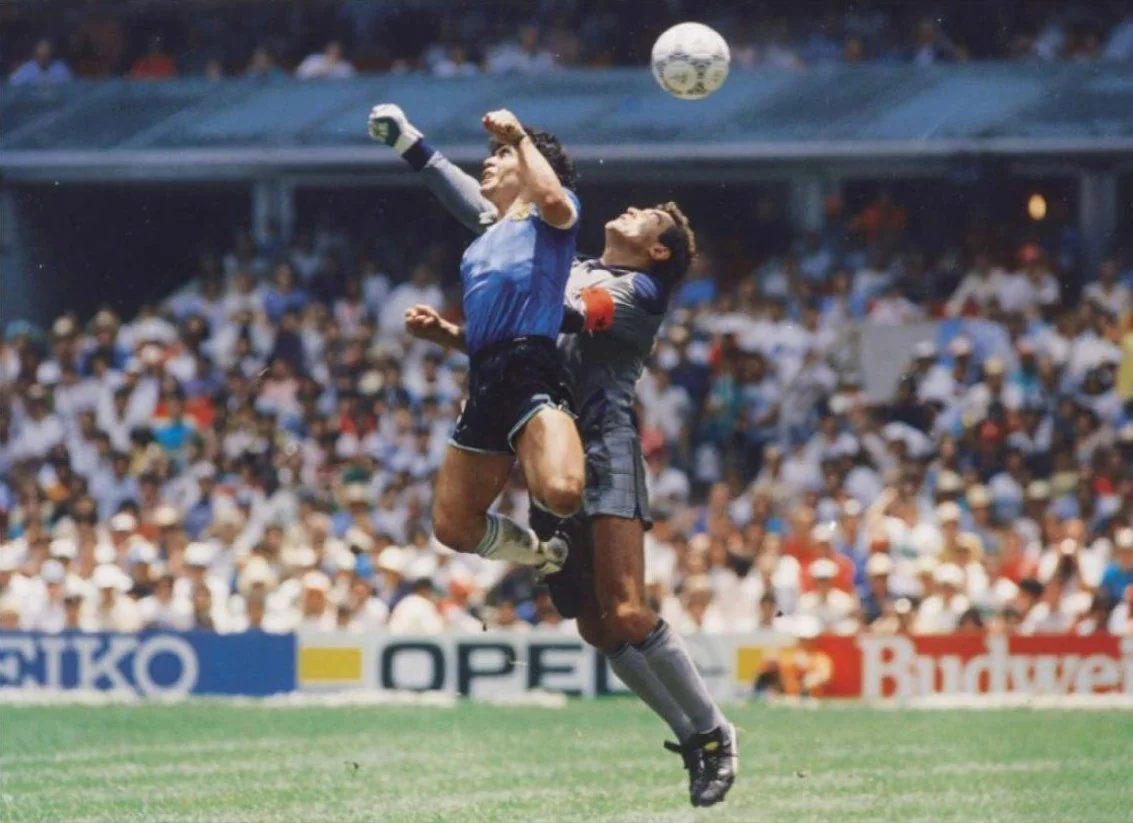
It was far more even than I remembered, with Maradona’s brilliance coming in flashes rather than through sustained dominance. And the ‘Hand of God’ incident came out of nowhere. It was, of course, a clear handball. Yes, Maradona, a natural-born cheat, tried to disguise it by flicking his head as he punched the ball into the net, but it was transparently obvious that the goal couldn’t possibly stand.
At home in Birmingham, that summer evening with Mum and Dad, I saw exactly what had happened, as did everyone else. We all saw it — the players, coaching staff, crowd and millions on TV (though strangely, at first, not Barry Davies who wrongly thought the England players were claiming an offside). But the referee didn’t, or didn’t want to, and nor did the two linesmen.
I felt disbelief, followed by horror. Even Mum looked shaken. Surely — surely!?— one of the two linesmen will intervene. Surely someone — anyone!?! — will. Surely the referee will accept the obvious. But no. The realisation that we’d been cheated hit me in a sickening instant. And any residual belief that England would stand or fall on their own efforts went in that one moment, never to return.
When, years later, France knocked Ireland out of a World Cup qualifying group because of a deliberate Thierry Henry handball, Henry was so mortified, and so racked with guilt, that he suggested the game be replayed.
But Henry is a gentleman. Maradona had no such shame or remorse. In fact, the opposite. He was clearly delighted with himself, celebrating wildly, and inspired enough to go on and score a goal which, to my continuing dismay, is repeated endlessly owing to its utter brilliance. You can’t avoid it. I’ve even seen it come out, in surveys of English football fans, as the Greatest Goal Ever. Even though it should never have been given, because the whole move started with a clear foul on Glenn Hoddle.
Was it that good a goal? Yes, I’m afraid so. It was fabulous. John Barnes had scored a similar one against Brazil in Rio two years earlier. But that was a friendly match. This was the World Cup quarter-final. It knocked the stuffing out of England, and at home in Brum I felt like someone had punched me in the stomach, then, two minutes later, smacked me in the face.
Well, one thing an England team never does is give up. Bobby threw on Barnes on the left-wing, who immediately jinked past a couple of players and crossed beautifully for Lineker, who headed the ball into the net. That made it 2-1, with still enough time to equalise.
What if? What if?
With renewed belief, England pressed. The ball went wide on the left to Barnes again, who curled in another perfect cross to Lineker, this time only a few feet out. I was up on my feet, punching the air, because surely he’d scored!
But no. Somehow, an Argentinian defender, in a moment of brilliant defending, had dived beneath Lineker and deflected the ball out and away. Lineker was in the net… but not the ball. And I held my head in my hands, unable to believe it. That was our last chance.
*
Some England players will never forgive Maradona for his cheating. Others, like Lineker, are more sanguine, saying that even if England had equalised, Maradona was so exceptional that he would have scored a third and knocked England out anyway. Perhaps they’re right.
Where do I stand? Well, of course, I’ll never forgive nor forget. It’s not in my makeup. But I also feel sorry for Argentina. The most famous goal that country has ever scored was a cheat. In contrast, England’s most famous goal — before I was born, sadly — was Geoff Hurst’s third in ’66. The fact that Maradona’s cheat, to this day, is celebrated in Argentina, says all you need to know. England may not have won, but at least they played honourably. Despite the pain, I’d far rather be us.