
In Medias Wrong
by Allie Bullivant
March 2026
When simply being Jewish is a provocation.
Last week a man with a rifle crashed into a Reform synagogue in Michigan. On sight, there were 140 children in daycare and preschool classrooms. Temple Israel was formed in 1941, during the height of the Holocaust, and was “dedicated to the Formation of a Jewish State” as The New York Times describes.
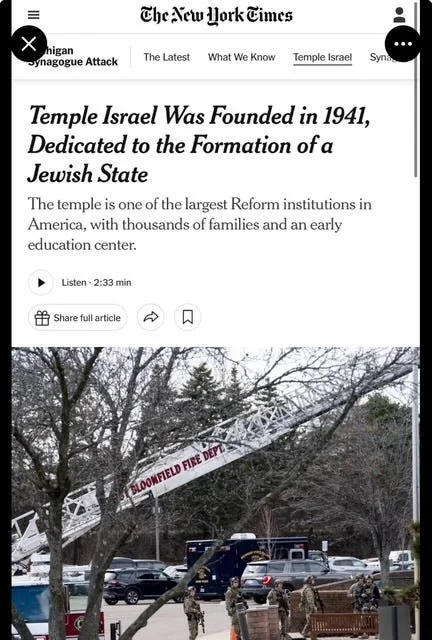
It’s a strange fact to highlight in the context of reporting on a murderer with a bomb in his car attempting a mass killing. But most mainstream media went even further. The New York Times, The Washington Post, TNY, PBS, and The Guardian (to name a few) all included headlines that led with how the attacker had lost Lebanese family members in the current war between Israel and Lebanon. To paraphrase these news outlets: “a man with relatives in Lebanon, a country thousands of miles away, lost some family members in the Lebanon war with Israel, so he attacked a shul in Michigan.”
Wars between Israel and Lebanon have been happening on and off for decades, in which Hezbollah and other Islamic jihadist groups shoot rockets at civilian centers in Israel repeatedly. As a result it is current regulation that all Israeli residences include a bomb shelter. Whether a tall apartment block with a large communal bomb shelter built a few stories below ground level, or, for single family homes, a private bomb shelter a few stories below ground level. In anticipation of such attacks from places like Lebanon.
More to the point, it sounds a whole lot like journalists are importing a rationale onto a unjustifiable, heinous action. In the vein of: she was asking for it.
Israel hurt his family; he attacked a synagogue in America. Why connect the two? Why imply what journalists imply here? That the attacker had a “reason” to do what he did?
There is no reason for attacks like the one in Michigan. There is no justification. It’s hate. There is no point of including language that suggests even an ounce of cause-and-effect in the case of a religious-or-ethnically-motivated-mass-killing.
Here’s a sampling of the first few headlines after a Google search for “Michigan synagogue attack.”
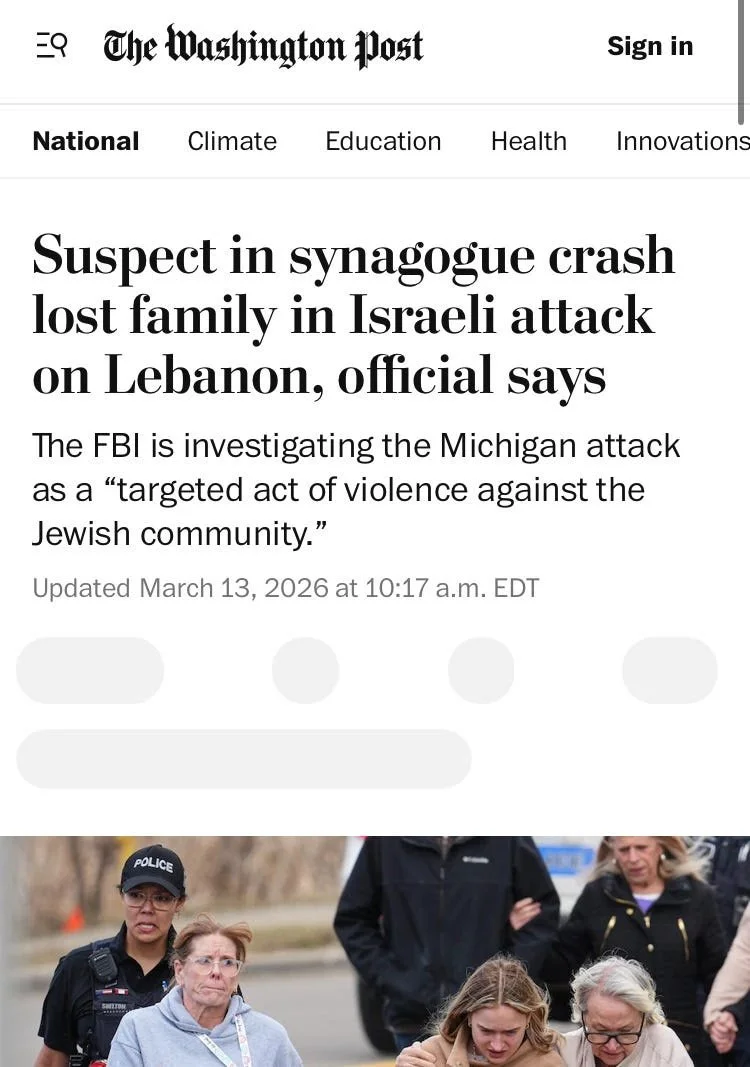
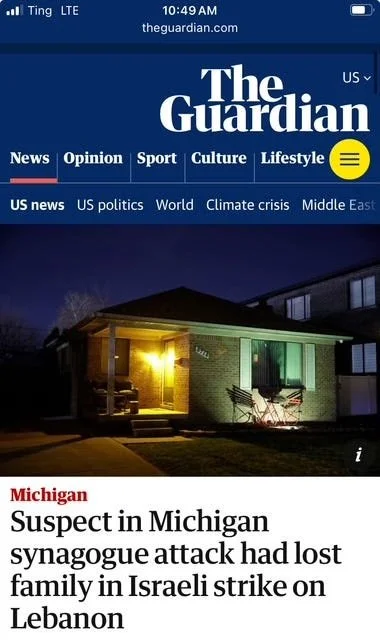
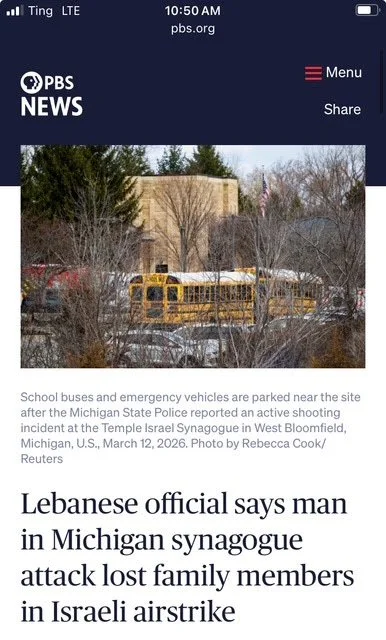
The equivalent headlines? “ISIS member attacks a British church, second cousin died in Mosul during Iraq War.” “Ukrainian Man Opens Fire at Russian restaurant in Pittsburgh, lost sister to Russia-Ukraine war.”
I haven’t come across any headlines like these before. Because it doesn’t happen. Both the types of attacks as an occurrence and the attribution of such a motive. Often, news outlets provide some profile of the suspect in a mass shooting or attack. But people get cagey if the attacker’s religion or race or sexual orientation are mentioned. Even poor or unstable mental health or mental illness is a no-go descriptor; it creates harmful associations for the depressed or mentally struggling community.
An attacker hating or seeking revenge against Israel and taking it out on American or European Jews? That’s not an off-limits characterization. Nor is it presented as extremist or absurd. For most of the mainstream media, it’s the opposite. It’s valid. So headlines like this are fine. It’s open season for sniping at Israel from whatever distance, no matter how much of a stretch, no matter how much hate is justified in ways it wouldn’t be if applied elsewhere.
Less than a week later, The Guardian described the existence of a Gail’s coffee chain (a franchise that was started by an Israeli) nearby to a Palestinian cafe in London as feeling like “an act of heavy-handed high-street aggression.” Pain aux raisin and vegan hot chocolate are aggression. All because an Israeli started the chain.
The truth is that any form of Jewish existence is increasingly viewed as antagonistic. Anywhere in the world.
Then again, that’s the reality at the heart of this conflict. You can believe what you want: that the Israeli-Palestine issue is about “apartheid,” settler colonialism, illegal settlements, the recent war, etc. But it’s not that about that. It’s not even an Israeli-Palestinian conflict, as Matti Friedman so eloquently describes in his famous essay. It’s a war between the Arab-Muslim world and the existence of one, small, thriving minority within: the Jews. In 1947, Ernest Bevin, British Foreign Secretary described the central issue perfectly: “We’re faced with an irreconcilable conflict. For Jews, the top priority is a Jewish state. For Arabs, it is resisting to the last any establishment of Jewish sovereignty” (emphasis mine).
We are now at a point where a glimpse of Jewish sovereignty — whether that is a Jewish nation where Jews can protect themselves from centuries of violence due to living as minorities within hostile cultures, or Jewish-run synagogues, or kibbutzim, businesses, schools, or interest groups — is seen as a provocation. Jewish existence is seen as an injustice or connected to an injustice. Therefore Jewish lives are legitimate targets. This is the real meaning of intifada, as any honest person can figure out. It’s not about “resisting injustice” or some vague, semi-admirable cause. Globalizing the Intifada means to attack Jews wherever they are.
The media has become so compromised that when one such horrific attack is planned on a Jewish shul with a daycare and 140 kids inside, those details are not part of the headline for many mainstream outlets.
Instead, what is emphasized is the attacker’s family in Lebanon.
Because, if it is Jews, of course they deserve it. Increasingly, a version of this thinking has become common everywhere you look.
But it won’t stand for me.